Table of Contents
- 1. What It Really Means When A Token Is Minted
- 2. How Token Minting Actually Works On A Blockchain
- 3. A Practical Look at Minting on Solana
- 4. Minting vs. Mining: Understanding The Difference
- 5. The Core DNA of a Token
- 6. How To Verify A Mint And Secure Your Project
- 7. Answering Your Top Crypto Minting Questions
What It Really Means When A Token Is Minted
Saying a token or NFT has been "minted" is just a cooler way of saying it has been brought into existence. This is the very first step for any digital asset, whether it's a utility token for a new DeFi project or a one-of-a-kind NFT representing a piece of digital art.
Let's use an analogy. Imagine you're an author planning a limited-edition print run of your book. Before a single copy is printed, you have to make some big decisions: how many books will exist in total? Who gets to authorize a reprint? What makes each copy authentic? Minting a token is the digital equivalent of this. You're setting the foundational rules and writing them directly into the blockchain's code.
The Digital Birth Certificate
This "birth" is actually a transaction that gets broadcast to the blockchain, officially registering the token and all its core properties. These details are what define how the token behaves for its entire life.
During the minting process, several key parameters are locked in:
- Total Supply: This sets the maximum number of tokens that can ever be created.
- Decimals: This determines the smallest fraction the token can be divided into, impacting how it's used.
- Mint Authority: This is the digital "key" that holds the power to create more tokens in the future (if allowed).
- Metadata: This is all the identifying information, like the token's name, its ticker symbol, and a link to its logo.
The act of minting transforms an idea into a tangible, on-chain asset. It's the moment a project's tokenomics move from a whitepaper to a verifiable reality, establishing authenticity and ownership from the very beginning.
Once the network confirms this creation transaction, the token is officially live. This event is permanent and can be seen by anyone, creating an unbreakable record of the asset's origin story. Getting your head around this is key, because it's the foundation for everything else—trading, staking, and building a community.
If you're curious about other crypto terms, you can find more definitions in our comprehensive glossary.
How Token Minting Actually Works On A Blockchain
Think about creating a limited-edition series of trading cards. Before you ever fire up the printing press, you first need a blueprint. This blueprint lays out all the rules: how many cards will exist, what they look like, and what makes them special. On the blockchain, this blueprint is a smart contract.
When you mint a token, you're not just making a digital picture; you're encoding its entire DNA into that smart contract. The process involves sending a transaction to the blockchain that contains all these core rules. Once network validators approve it, your tokens officially spring into existence as real, verifiable assets.
Fungible Vs Non-Fungible Tokens
The minting process looks a bit different depending on what you're creating. In the crypto world, tokens generally fall into two buckets, and the distinction is key.
- Fungible Tokens: These are all identical and can be swapped for one another, just like dollar bills. My dollar is worth the same as your dollar. When minting fungible tokens, you usually create the entire supply at once—say, 1 billion tokens—that can then be divided and traded freely.
- Non-Fungible Tokens (NFTs): Each one of these is totally unique, like an original painting or a front-row concert ticket. Every NFT is minted individually with its own unique ID and data, proving it's a one-of-a-kind item.
This difference is fundamental because it changes how you handle the supply. A fungible token has one big pool of identical units, while an NFT collection is made up of many distinct, individual assets. You can get a deeper look at the whole process in our guide on how to create a cryptocurrency token.
Key Insight: Minting is essentially the act of deploying a smart contract with predefined rules onto the blockchain. The network's validation of this contract is the official moment of creation, turning code into a transferable digital asset.
Of course, for any of this to happen, you need a blockchain capable of running these smart contracts. Platforms like Solana have become a go-to choice for minting, thanks to their blistering speed and incredibly low transaction fees.
This efficiency has turned the Solana network into a hotspot for new projects. As of early 2024, Solana had been the launchpad for over 33 million NFT mints, generating more than $3 billion in total sales. With minting costs often dipping below $0.10 per mint, the barrier to entry is practically gone. This affordability empowers creators everywhere to launch their ideas without breaking the bank.
A Practical Look at Minting on Solana
While minting is a universal concept in crypto, the Solana blockchain and its SPL (Solana Program Library) token standard really bring it to life. Thanks to its lightning-fast speed and rock-bottom costs, Solana has become the go-to playground for everyone from serious DeFi builders to viral memecoin creators.
When you mint an SPL token, you're doing more than just creating a digital coin. You're effectively writing its economic DNA—the set of rules that will govern it forever. This process locks in a few critical parameters on the blockchain, making them transparent and permanent for all to see.
Defining Your Token's Core Rules
Think of the minting transaction as filling out your token's official birth certificate. This is where you establish its most fundamental properties.
You'll need to define a few key parameters:
- Total Supply: What's the maximum number of tokens that can ever exist? You might set a fixed supply of 1 million, or you could retain the ability to create more later.
- Decimals: How divisible is your token? A token with 9 decimals can be split into tiny fractions, perfect for a currency. A token with 0 decimals, on the other hand, can only exist as a whole number, like a unique collectible.
- Authorities: Who's in charge? You must assign separate "authorities" for minting new tokens and for freezing accounts. This is a massive feature for security and establishing trust.
On Solana, minting creates a special on-chain "mint account." This account doesn't hold the tokens themselves. Instead, it serves as the master blueprint, storing all the rules like total supply and who has the authority to change things.
Once these rules are set in stone, the actual tokens are created and can be sent to a wallet. To hold a specific SPL token, a user needs an Associated Token Account. It's a special sub-account tied to their main wallet, designed to hold only that one type of token. It's like having a separate, labeled drawer for each currency you own—it keeps everything organized and secure.
This simple but powerful system has led to an explosion of innovation. In 2024 alone, users launched a staggering 11 million tokens on Solana, with minting costs often under $0.10 each. Platforms like Pump.fun have seen over $1 billion in trading volume, demonstrating the network's incredible scale. It's this accessibility that has so many people asking, "what does minted mean in crypto?"
Minting vs. Mining: Understanding The Difference
It's a common mix-up in the crypto world: people often use "minting" and "mining" as if they mean the same thing. In reality, they're two fundamentally different processes. Confusing them is a bit like confusing the author of a book with the printing press that publishes it—one is about creating the content, and the other is about running the machinery that makes it all work.
At its core, minting is all about creation. When you mint a token, you're officially bringing a brand-new digital asset into existence on the blockchain. This process is governed by a specific set of rules written into a smart contract.
Mining, on the other hand, is about validation and keeping the network secure. Miners are the workhorses of certain blockchains, solving incredibly complex math problems to verify transactions and add them to the official record.
This diagram helps clarify how minting (the act of creation) differs from mining (the act of validation).
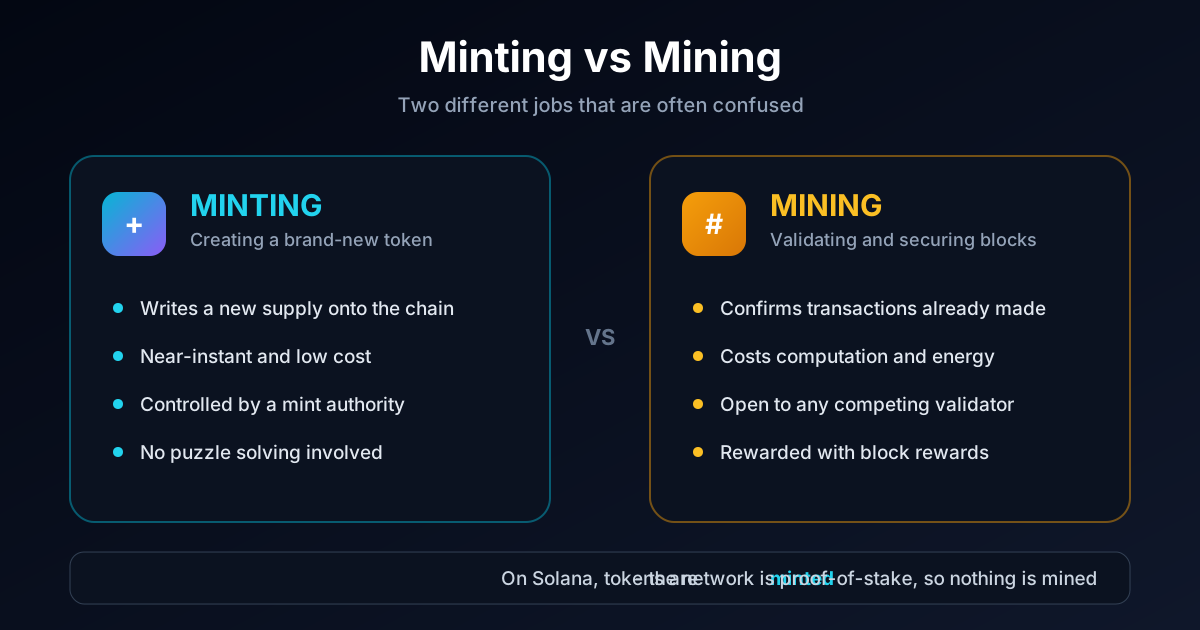
Core Distinctions At A Glance
Minting is an act of origination, while mining is an act of maintenance. A newly minted SPL token on Solana is created on command by whoever holds the "mint authority." In contrast, the new Bitcoin a miner receives is their reward for doing the hard computational work that keeps the Bitcoin network running and secure.
This leads to a massive difference in the resources required. Mining, especially on Proof-of-Work networks like Bitcoin, is notorious for its high energy consumption. It demands powerful, specialized computers running around the clock. Minting a token on an efficient Proof-of-Stake network like Solana? It uses a tiny fraction of that energy, often less than what it takes to do a simple web search.
The key takeaway: Minting creates assets, while mining secures the network. One is an administrative function defined by a smart contract, and the other is a competitive process that powers the blockchain itself.
To really nail down the differences, it helps to see them side-by-side.
Comparison of Minting and Mining
This table breaks down the key distinctions between these two critical blockchain functions.
| Aspect | Minting | Mining |
|---|---|---|
| Primary Goal | To create new tokens (fungible or NFTs) and record them on the blockchain. | To validate transactions, secure the network, and add new blocks to the chain. |
| Mechanism | Follows rules in a smart contract; often a simple, on-demand transaction. | Solves complex cryptographic puzzles (Proof-of-Work) to win the right to add a block. |
| Energy Use | Extremely low, especially on Proof-of-Stake chains like Solana. | Very high, requiring significant computational power and electricity. |
| Who Can Do It | Anyone with the designated "mint authority" for that specific token. | Anyone with specialized, powerful hardware who joins the network's mining pool. |
As you can see, while both are essential to the crypto ecosystem, they serve completely separate purposes and operate on vastly different scales of complexity and resource consumption.
The Core DNA of a Token
When you bring a new token into existence, you're not just creating a digital asset; you're setting its fundamental rules in stone. These parameters, locked onto the blockchain during minting, define everything from its supply mechanics to its governance. They are the token's permanent DNA, so getting them right from the start is absolutely critical.
These settings are what build trust with your community. They determine who holds the keys, how the token behaves in the wild, and whether its economic model is stable or subject to change.
The Power Switches: Mint and Freeze Authority
Think of Mint Authority as the key to the token printing press. The wallet holding this power is the only one that can create—or mint—new tokens. If the creator decides to keep this authority active, they can increase the total supply whenever they choose. This has massive implications for the token's value.
On the other hand, Freeze Authority is a less common but powerful tool. It gives a specific wallet the ability to lock tokens in an owner's account, preventing them from being transferred. While it sounds drastic, this feature is sometimes used by projects needing to meet strict regulatory rules, giving them a way to pause activity if a situation demands it.
A project's choice to keep or give up its mint authority is a huge signal to its community. When authority is revoked, it creates a fixed, unchangeable supply. This assures investors that their stake won't be watered down later by someone printing a billion new tokens out of thin air.
Decimals, Supply, and Scarcity
Beyond who holds the power, a few other settings are essential for shaping your token's usability and long-term economic health.
- Decimals: This little number dictates how finely your token can be divided. A token with 9 decimals, for example, can be broken down into one-billionth of a unit, which is perfect for micro-transactions. In stark contrast, an NFT is a single, indivisible item, so it has 0 decimals. Matching the decimal count to your token's purpose is a must.
- Burn Functions: "Burning" a token is the crypto equivalent of shredding cash. It involves sending tokens to a dead-end address where they can never be recovered, permanently removing them from circulation. Projects do this to reduce the total supply, creating a deflationary pressure that can, in theory, boost the value of the tokens that remain.
These foundational elements—mint and freeze authority, decimals, and burn mechanics—are the bedrock of any token. Making thoughtful, transparent decisions about them during the minting process is one of the most important steps toward building a credible and successful project.
How To Verify A Mint And Secure Your Project
So, your token is officially minted and exists on the blockchain. That's a huge milestone. But now what? How do you prove its details to your community, and what are the absolute must-do steps to keep your project safe?
Verification and security aren't just technical chores; they are the bedrock of trust. This all starts with a tool called a block explorer. For anyone on the Solana network, a platform like Solscan is your indispensable window into the blockchain. It lets anyone, anywhere, look up your token and see its real-time, on-chain data, proving that what you say about your token is the absolute truth.
Verifying On-Chain Data With A Block Explorer
Using a block explorer is surprisingly simple. Just grab your token's address, paste it into the search bar, and it will pull up every detail imaginable. This public record is your token's source of truth, leaving zero room for doubt about its core properties.
Key things to double-check on a block explorer:
- Total Supply: Does this number match exactly what you've promised in your whitepaper or to your community?
- Authorities: Who has control of the mint and freeze authorities? Are they still active, or have they been properly revoked?
- Transaction History: You get a full, transparent log of every single transaction, from the initial mint to every recent transfer.
This is the real power of blockchain technology. It completely gets rid of the need for "trust me." Instead, it empowers everyone with "verify it yourself."
Essential Security Practices After Minting
Verification is the first step, but locking down your project for the long haul demands a disciplined game plan. After the mint, your priority has to shift to protecting your assets and cementing your community's trust. This is where best practices become non-negotiable.
First off, always test everything on a devnet before you even think about launching on mainnet (the live blockchain). A devnet is a free-to-use sandbox that mirrors the real network. You can mint tokens, break smart contracts, and find bugs without any real-world risk or cost. Skipping this is like trying to launch a rocket without running a single simulation—it's just asking for trouble.
The single most powerful action you can take to build community trust is to revoke your mint authority once the initial token supply is created. This permanently removes your ability to create more tokens, proving to the world that the supply is fixed and cannot be manipulated.
Finally, the entire security of your project boils down to how well you guard your private keys. Consider these absolute must-do security steps:
- Use a Hardware Wallet: Keep the private keys for any authority wallets on a physical hardware device like a Ledger. Never leave them in a browser extension or on a computer that's connected to the internet.
- Revoke Unnecessary Authorities: If your token doesn't need a freeze function, get rid of the freeze authority immediately. Every active authority is a potential weak point. You can learn more about managing these features in our guide on advanced token features like mint and freeze authority.
- Practice Good OpSec (Operational Security): Never share your private keys or seed phrase. Don't click on suspicious links. Be skeptical of every DM and unsolicited offer you receive.
By verifying your token's on-chain data and adopting these critical security measures, you aren't just protecting your project—you're building the confidence and trust essential for long-term success.
Answering Your Top Crypto Minting Questions
Now that we've walked through the mechanics, let's tie it all together. When people first start exploring token creation, a few questions always pop up. Here are the most common ones, answered straight.
What Is Mint Authority and Should I Get Rid of It?
Think of mint authority as the master key to your token's supply. Whoever holds it has the sole power to create new tokens. It's literally the key to the digital printing press.
So, should you get rid of it? Absolutely.
You should revoke this authority the moment your initial supply is minted. This is a massive trust signal for your community. It proves, on-chain and forever, that you can't just create more tokens out of thin air and dilute everyone's holdings. It's one of the single best things you can do to show your project is legit and secure.
Can I Create More Tokens Later?
Technically, yes—but only if the mint authority is still active. If that key hasn't been thrown away (revoked), the holder can mint more tokens whenever they want.
But once that authority is revoked, it's game over. No new tokens can ever be created, period. The supply is permanently capped.
Quick Aside: Freezing vs. Burning — Don't confuse minting with freezing or burning. Freezing is temporary—it just pauses token transfers and can be undone. Burning, on the other hand, is permanent. It destroys tokens by sending them to a dead-end address, which actually reduces the total supply.
How Much Does It Really Cost to Mint on Solana?
This is where Solana shines. The network fees (or "gas") you'll pay to mint a brand-new SPL token are almost unbelievably low—often under $0.10 per mint. That rock-bottom cost is a huge reason why Solana has become the launching pad for everything from massive DeFi protocols to the latest viral memecoin. It basically removes the financial barrier, letting anyone with a good idea bring it to life.
Conclusion
Understanding what "minted" means in crypto is the foundation for everything that follows. It's the moment a project moves from idea to on-chain reality—a permanent, verifiable record that a new digital asset exists. Whether you're creating a fungible SPL token on Solana or minting a one-of-a-kind NFT, the process follows the same principle: write the rules into the blockchain, and they're there forever.
The key takeaways are simple: minting creates assets while mining secures networks, your mint authority is your most powerful (and dangerous) key, and transparency via block explorers is your best tool for building community trust. Get these fundamentals right, and you're well on your way to a credible project.